Well my friends, I was asked to write an article for the fine campus publication "
The Irish Rover" on the Pope's journey to Turkey. I had a lot of fun researching and composing it, but because of my inherent nature as a historian, it turned out to be rather long and detailed.
Because of a lack of space they had to chop it in half. I could deal with that because I know how these things go. However, I could not help but think as I read the edited version at layout last night "this isn't my article!" Indeed, it wasn't mine. This morning when I opened the paper I saw about the article "Mary Liz Walker." WALKER? Oh silly Rover staff...that is not my last name. Some how they managed to get my email address (which includes my properly spelled last name) correct at the end of the article.
That aside, here is the unedited version of the article I threw together:

St. Paul preached there, Saints John and Peter helped build the church there. St Philip was martyred there. It is even told that the Blessed Virgin Mary lived in Ephesus for some time. In 380 Christianity was declared the official religion of the state, but today Turkey is a far cry from a pious land of Catholic devotion.
The Great East-West Schism of eleventh century split the vast majority of Catholics living in Turkey from the Roman Catholic Church and the authority of the Pope. However, in 1453, after centuries of military turmoil the capital of Turkey, then Constantinople, fell to the invading Islamic Ottomans who declared their own faith to be the state religion and, while they consented to permitting the Orthodox Patriarchate to continue, they converted city's cathedral, Hagia Sophia – the Church of Holy Wisdom – into a Mosque. It is in this state that Turkey remains today – an overwhelming Islamic nation with small pockets of Catholic and Eastern Orthodox Christians.
"Tense" is perhaps a fair word that most would use to describe the religious situation of Turkey today. But, in September 2005, the President of Turkey invited the pope to visit. The last papal visit was by John Paul II in 1979. Though nearly thirty years would seem like a long period for the pope to not visit a country so close to Rome, the tension and attitude of the majority of the population suggested the people wished it would be made longer.
Only a couple days before the Holy Father left Rome, Muslim Turks took their anger to the streets. On November 26 over 25,000 protesters organized by the pro-Islamic group "Felicity" filled Istanbul to denounce the Pope and his comments in Regensburg and exhibit general resentment towards the scheduled visit. Besides the general contempt of the common protester, the Prime Minister, Recep Tayyip Erdogan, and foreign minister, Abdullah Gul, were reported to be leaving town to attend a NATO conference and therefore would be unable to greet the Pope. Fortunately, the day of Benedict's arrival, the Prime Minister decided to briefly delay his flight in order to greet the Pontiff at the airport. While the NATO meeting may have been passed off as poor timing, but the lack of flight coordination inexcusable, Fr. Jonathan Morris writes: "While the political could shoulder is a tactical move before elections, and should not be considered anything more, it is indicative of an underlying distrust within public opinion of all things 'Benedictan.'" Hostility, distrust, hatred, or coldness – nothing deterred the courageous Holy Father. Students and faculty at Notre Dame waited anxiously for the journey to come. Whispers could be heard in the halls "did you hear the number one book in Turkey is about who will kill the pope?" (for in fact the bestselling book was the novel "The Plot Against the Pope," which featured on its cover a cross being consumed by fire, and soldier aiming a rocket launcher the Pope) and "Do you think he'll make it out?" The eve before the Benedict left Rome, Fr. Matthew Miceli C.S.C. offered the nightly Mass in Zahm Hall for the safety of the Holy Father and spoke of the bravery the pope in visiting such hostile territory in order to reach his flock of faithful and extend a hand to those of other faiths.
Indeed, the Pope's mission for Turkey was threefold. The Office of Papal Liturgical Celebrations explained the journey was to be pastoral, ecumenical, and "a journey under the banner of interreligious dialogue." These goals were to be reached through several Masses said for the Roman Catholic faithful and some ecumenical prayer services.
On Tuesday, November 28, Pope Benedict landed at Esemboga International Airport in Ankara where the President of the Republic, Ahmet Necdet Sezer, received him. Later that day Pope Benedict addressed Turkish religious leaders, particularly Ali Bardkoglu, President of the Religious Affairs Directorate, who was among the first to denounce the Pope's speech at Regensburg. In that address, the Holy Father extended true charity by praising the Turkish people and calling for "fraternal respect with which Christians and Muslims can work together." From that meeting, Benedict meet with the Diplomatic Corps to the Republic of Turkey where he declared: "Turkey has always served as a bridge between East and West, between Asia and Europe, and as a crossroads of cultures and religions." He continued to praise the development of the nation and its decision to recognize freedom of worship and conscience, and again he called for dialogue and respect.
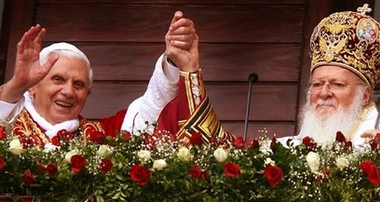
The next day, Wednesday November 29, Pope Benedict celebrated Mass before the Shrine of Meryem Ana Evi in Ephesus, which is traditionally held to be the place the Blessed Virgin Mary Lived for sometime before her death. In his homily he spoke of the Mary as the Mother of the Church and Mother of Unity, and Christ as grace and peace. He prayed for peace for Jerusalem and the entire world saying, "Against the backdrop of universal peace, the yearning for full communion and concord between all Christians becomes even more profound and intense." From the shrine of Our Lady, the Holy Father had a historical meeting with the Ecumenical Patriarch of Constantinople, His Holiness Bartholomew I at the Patriarchal Cathedral of Saint George in Istanbul where acknowledged the saints and theological contributions of the East to the West, such as Doctors of the Church Gregory of Nazianzus and John Chrysostom. He expressed his hope that meeting would "strengthen our mutual affection and renew our common commitment to persevere on the journey leading to reconciliation and the peace of the Churches."
The next day, Wednesday November 1, marked a particularly important day in the travels of the pope as it was the Feast of Saint Andrew – a saint held in most high esteem by both the Catholic and Orthodox Churches and is the patron saint of the Church of Constantinople. There the Holy Father delivered a most beautiful address, which again stressed the need for fraternal dialogue and the reconciliation of the East and West. Just as Andrew and Peter were brothers called together by Christ to be fishers of men, so should the two churches not be separated, but work together as the did holy brother apostles. After the liturgy, Pope Benedict and Patriarch Bartholomew signed a common declaration vowing to advance the fraternal and theological dialogue that hopefully may reunite the churches someday, as well as to address issues that threaten religion today including "secularization, relativism, even nihilism." Additionally they affirmed a positive view of the European Union, but stressed it must respect the inalienable rights of the human person and protect and preserve its "Christian roots, traditions, and values." They did not neglect to express concerns with poverty, war, terrorism, unlimited technology, threats to the natural environment, and called for peace in the Middle East.
Later that day the Holy Father visited the museum of Hagia Sophia and spoke with several other ecumenical religious leaders including the Armenian Apostolic Patriarch and the Grand Rabbi of Turkey. That night dined with member of the Catholic Episcopal Conference.
On the last day of his visit, Thursday December 1, Pope Benedict celebrated Holy Mass at the Cathedral of the Holy Spirit before which he released a dove, a symbol of peace, reconciliation, and the cathedral's patron. During his homily he expressed joyful thanksgiving for his pastoral visit to Turkey and he prayed: "Brothers and sisters, let us now hand over our desire to serve the Lord to the Virgin Mary, Mother of God and Servant of the Lord. She prayed in company with the Apostles in the Upper Room, in the days leading up to Pentecost. Together with her, let us pray to Christ her Son: Send forth, O Lord, your Holy Spirit upon the whole Church, that he may dwell in each of her members and make them heralds of your Gospel!"
Once back in Rome, Catholics everywhere felt more than just relief that the Holy Father's trip was not met with tragedy, but instead served as a beacon for people throughout the world as a model of true Christian courage and charity. Pope Benedict's themes of fraternity, peace, dialogue, and reconciliation hopefully will not be ignored by the world during this period of tension, violence, and war. May our Holy Father serve as an inspiration for us all, and may we in turn strive to live out the Christian ideals he expressed.




 Posts
Posts